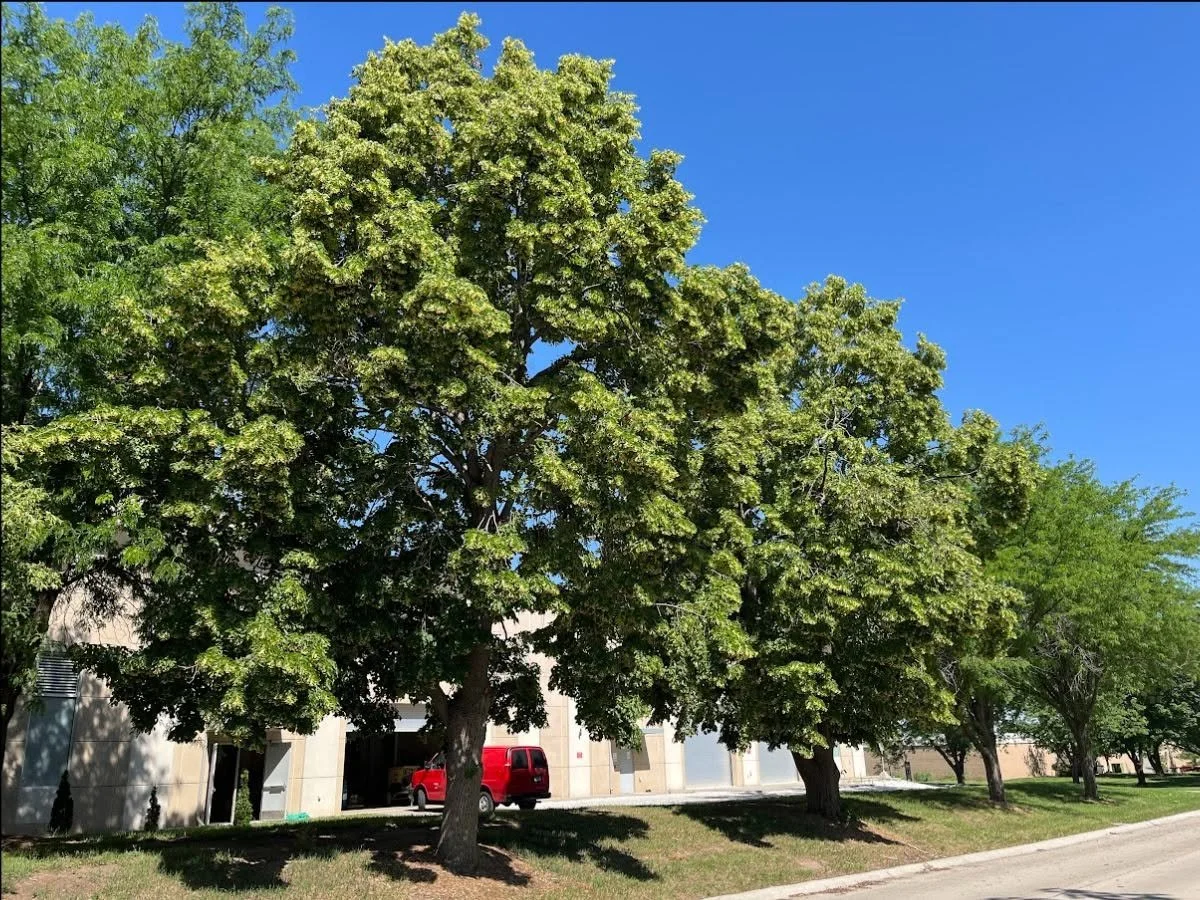
Wow. American Linden
A delightful botanical fragrance to experience this time of year is that of a flowering linden tree (basswood). A big linden can perfume an entire block and an incredible variety of insects will be enticed from far and wide to come partake in the sweet nectar of the flowers and work their magic for pollination. American linden trees are now blooming in eastern Nebraska, so we’ll make them (and their cousins) the Woody of the Week.
American linden (Tilia americana) is terrific tree for Nebraska and much of the Great Plains. It’s known for its fairly large heart-shaped leaves (4-5” wide) with serrated edges, and it’s soft, easy to saw-through wood. The tree will grow fairly quickly to 50-70’ tall with a pyramidal and uniform shape for much of its life, eventually becoming rounded in maturity. The sweetly scented, yellow flowers are about ½” in diameter and hang from drooping clusters suspended from a light-green leaf-like bract. These flowers are favored by a wide variety of pollinators including various bees, flies and beetles. Linden flowers are a favorite of honeybees and linden honey is highly prized for its citrus and minty undertones. Pollinated flowers turn into small, round, tan-colored nutlets about the size of a peppercorn. Fall color is often a nice yellow, with the tree being mottled in greens and yellows over several weeks of late summer and early fall.
American linden is native to much of the eastern US and Midwest and actually reaches its western native limits along the Niobrara River near Valentine, Nebraska. The tree is also commonly called basswood, which is an historical corruption of the word “bast”, which is the fibrous inner bark of the tree that was used to make ropes, mats and baskets by Native Americans and early settlers. So, technically it should have been called bastwood. The scientific Genus name Tilia originates from the Indo-European word ptelea meaning “broad” in reference to its wide leaves.
Two related species that grow well in Nebraska are the littleleaf linden (Tilia cordata) and silver linden (Tilia tomentosa). Littleleaf linden looks quite similar to American linden, but with smaller leaves and a more pyramidal shape. Silver linden is similar in form to American linden, but with darker green leaves that have a noticeably fuzzy and silver underside. A big, dark-green tree festooned with silver tufts is quite a sight to behold in the summer. Littleleaf linden is native to much of Europe and reaches into western Asia. Silver linden is native to southeast Europe and the Balkans. In England, lindens are known as lime trees for some reason. In my opinion, the best tree of the bunch is our native American linden, although the littleleaf linden can be a good choice for western Nebraska where the tree palette is more limited. Something to keep in mind is that Japanese Beetles are especially attracted to lindens and littleleaf linden can become nearly defoliated by late summer when beetle populations are high. American linden and silver linden are generally less disfigured than littleleaf linden.
As I mentioned earlier, linden has soft wood and very pliable branches. They are easier to get a saw through than almost any other hardwood. Despite that pliability, lindens are fairly storm-resistant when properly managed. The shape of a linden is pyramidal and its lower branches are often pendulous and downward reaching. This can make linden somewhat difficult to use as a canopy shade tree since they look awkward when limbed up high. Where space allows, leaving the low branches on a linden can be a good way to cover the ground and create a fun place for kids to find shelter and seclusion – and branches to climb.
Article compliments of the Bellevue Tree Board.